


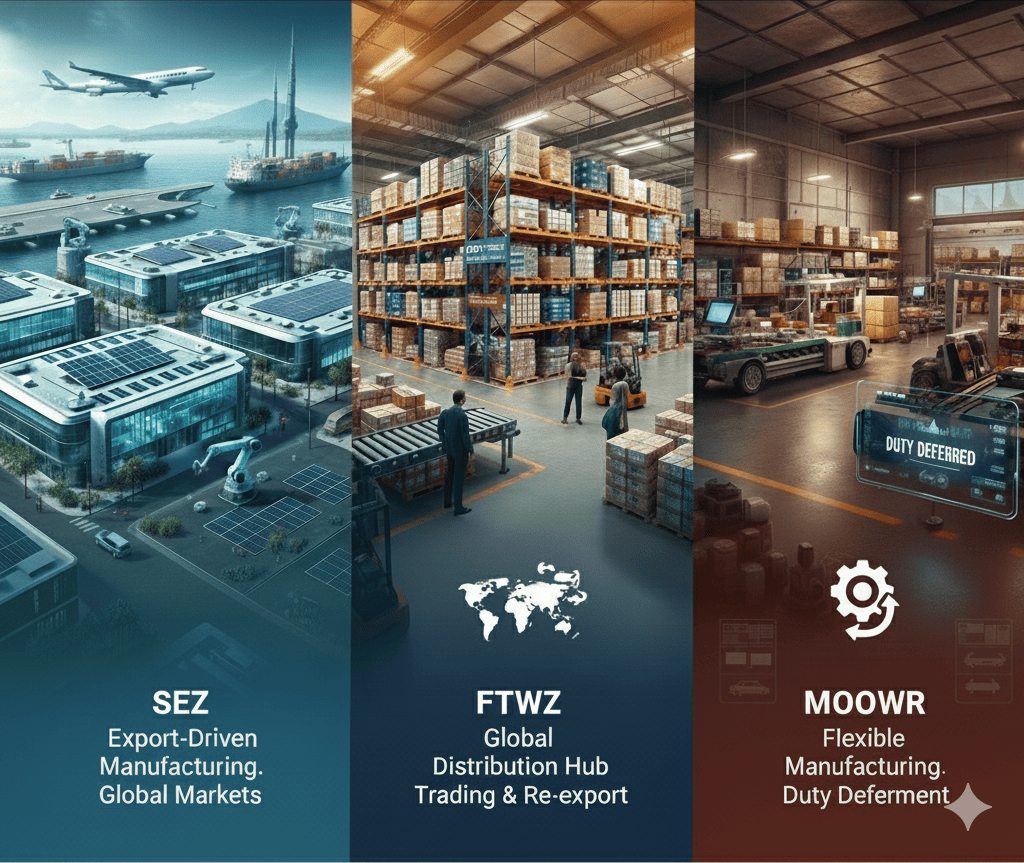
Before we go more into details of the subject, let us first understand the term Warehousing. What is Warehousing? It is the storing of goods and materials in a designated space for a period before they are sold, distributed, or manufactured. Now going beyond the scope of the basic warehousing different options were created to assist businesses to be cost efficient, looking for duty deferments and the possibilities of selling of the shelf. This gave rise to SEZ (Special Economic Zone), FTWZ (Free Trade Warehousing Zone) and MOOWR (Manufacturing & Other Operations in Warehousing Regulations).
An SEZ (Special Economic Zone) is a specially designated area where businesses can operate with several tax and customs benefits. Goods imported into an SEZ are not subject to customs duties until they leave the zone for domestic use.
Companies focusing on exports or international trade, especially in sectors like manufacturing, electronics, IT, Jewellery Pharmaceuticals and other export-oriented services.
Free Trade Warehousing Zone is a Special Economic Zone wherein mainly trading and warehousing and other activities related thereto are carried on. It is a deemed foreign territory like other SEZs within the geography of the country for businesses to benefit from tariff and trade.
Businesses involved in international trading, import and exports, reexport of cargoes, distributors, etc who want to work in an environment of reduced regulator compliances, duty free imports and facilitation of reexports. Logistics companies who represent big businesses too can set up FTWZ facilities on behalf of their customers.
MOOWR (Manufacturing and Other Operations in Warehouse Regulations) is a government scheme that allows businesses to defer customs duties on imported raw materials and capital goods for manufacturing without any export obligation. Sectors in Electronics, automobiles, chemicals, pharmaceuticals and engineering can benefit from this scheme.
Companies that sell both domestically and internationally can use this scheme to their advantage where they can defer the duties on DTA (Domestic Tariff Area) sales thereby improving their cash flow and paying duty at the time of clearance for DTA sales. Duties and IGST are saved if the goods are exported or transferred from one MOOWR to another. Foreign Companies as well as domestic companies wanting to take advantage of make in India should use these schemes to their advantage.
| SEZ | FTWZ | MOOWR |
|---|---|---|
| A designated area built mainly for export-driven businesses. | A specialised zone for international trading and warehousing. | A manufacturing bonded warehouse where goods are manufactured in India. |
| Best for: Companies that want to produce or offer goods and services for global markets. | Best for: Businesses that move goods across countries and need efficient storage or off the shelf storage | Best for: Companies that want to manufacture goods locally, internationally or domestically while keeping costs low. |
| Functions like a dedicated export ecosystem. | Functions like a global distribution centre. | Functions like a flexible, duty-differed manufacturing unit |
| Good for: Firms that want a long-term presence in an export cluster. | Good for: Businesses that need quick, smooth re-export operations. | Good for: Manufacturers that want easy setup and operational operational flexibility to sell locally or internationally or transfer to other MOOWR units |
| Popular among: Export and international manufacturers and service companies. | Popular among: Importers, re-exporters traders, and logistics players. | Popular among: Manufacturers, assemblers, and processors. |
